
The Next Decade of Finance Is Tokenized - Where Kava Fits
The global financial system holds hundreds of trillions of dollars in assets. Sovereign debt, commodities, cash equivalents, yield-bearing instruments - the building blocks of wealth and commerce that power economies worldwide. Today, only a tiny fraction of those assets exist onchain. That gap is closing fast, and the networks positioned to bridge it will capture extraordinary value.
This is the core of the Kava thesis for 2026 and beyond: tokenized financial assets will grow from a niche crypto use case into a multi-trillion dollar infrastructure layer. Stablecoins are the first proof point. What comes next is far bigger. And Kava has been building the right infrastructure for precisely this moment.
The Trillion-Dollar Real World Asset Migration
There are broadly two categories of crypto assets. The first is speculative and digital-native - memecoins, NFTs, low-quality tokens driven by narrative rather than fundamentals. The second is tokenized financial assets: onchain representations of real-world financial value including stablecoins, tokenized commodities, yield-bearing dollar products, and structured instruments.
The first category captured headlines during the last cycle. The second category will define the next decade.
The thesis is straightforward: people everywhere want access to the best financial assets the world has to offer. Historically, geography determined opportunity - if you lived outside major financial centres, high-quality instruments were expensive or impossible to access. Onchain infrastructure changes that equation entirely. Tokenization makes sovereign debt, dollar-denominated yield, commodities exposure, and structured financial products globally accessible to anyone with a wallet.
We believe tokenized financial assets will grow into the trillions as onchain rails become the primary global access layer for high-quality financial instruments. The infrastructure that supports this migration - settlement, custody, compliance, liquidity - becomes the most strategically valuable real estate in crypto.
Stablecoins: The Leading Edge of Tokenised Finance
Within tokenized financial assets, stablecoins are the largest and most mature category. They represent tokenized dollars - the dominant onchain derivative of real-world financial value and the primary settlement layer for virtually all onchain financial activity.
But stablecoins aren’t just a product category. They’re a gateway. They function as the on-ramp into tokenized asset exposure, the off-ramp back into fiat liquidity, and the base unit of account for every onchain financial product that follows. Growing stablecoin usage is the first step toward growing adoption of the entire tokenized financial asset stack.
As we covered in our recent analysis of the stablecoin infrastructure shift, Tron’s overtaking of Ethereum for USDT dominance validated a critical thesis: purpose-built payment infrastructure outcompetes complex general-purpose solutions when it comes to moving value at scale. Networks that made the right architectural choices are winning real market share.
This same logic applies to the broader tokenized asset opportunity. The networks that build native, efficient infrastructure for tokenized financial products - rather than retrofitting speculative-era architecture - will capture disproportionate value as the market matures.
Kava’s Structural Advantage
Kava didn’t stumble into this position. The network has spent years building infrastructure that aligns precisely with where the market is heading.
Native USDT integration gives Kava first-class stablecoin infrastructure rather than relying on bridged assets with their inherent fragility. Integrations with major partners like Binance provide distribution and liquidity access that smaller networks struggle to replicate. And the ability to deepen stablecoin liquidity through on/off-ramp partnerships creates compounding network effects - more liquidity attracts more users, which attracts more liquidity.
The strategic sequence is clear. Step one: grow stablecoin liquidity and usage within the Kava ecosystem. This is the foundation - the settlement infrastructure that everything else builds on. Step two: use stablecoins as settlement infrastructure for new financial products that bring tokenized real-world asset exposure to a global audience.
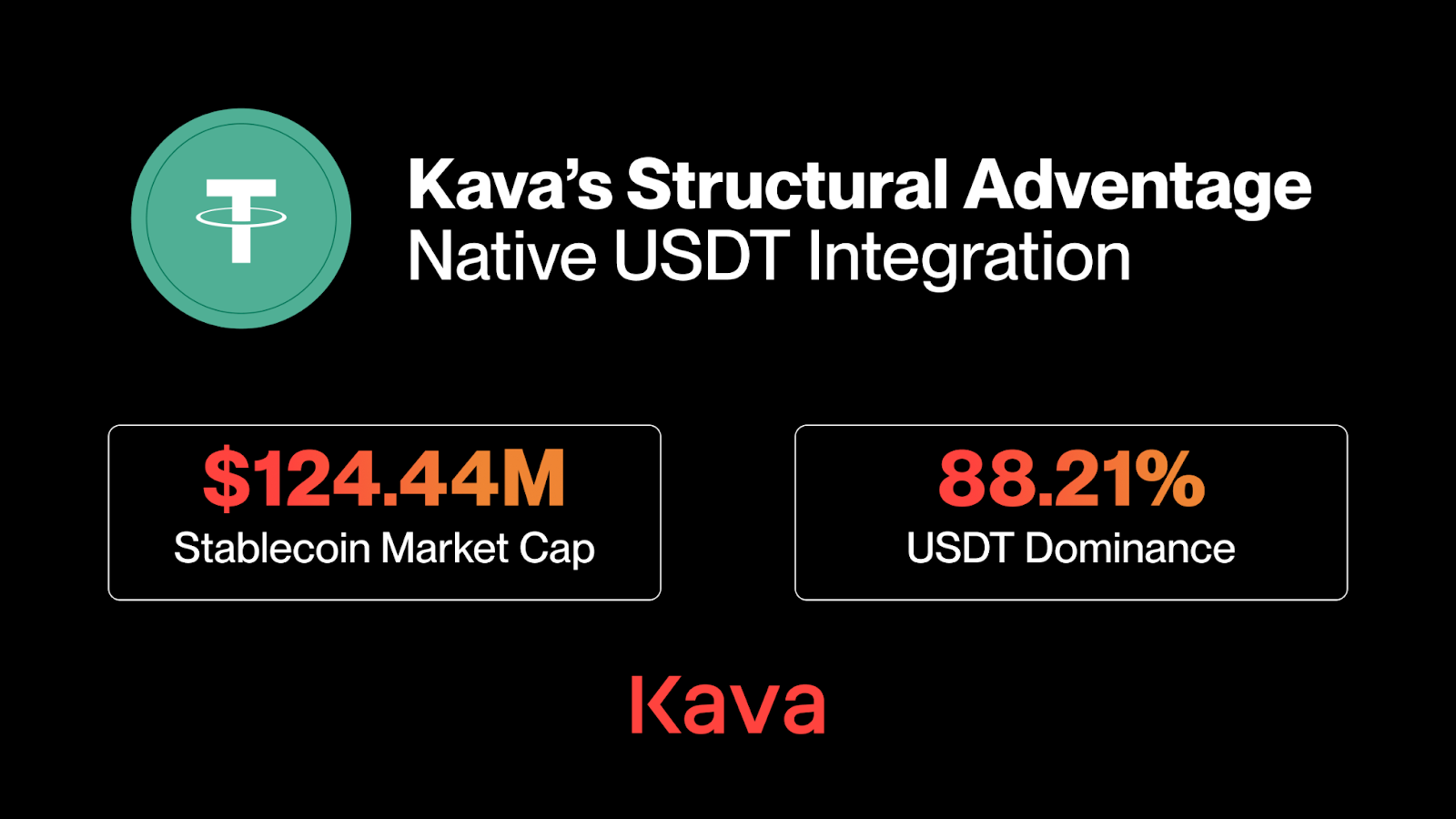
With $124.44 million in stablecoin market cap and 88.21% USDT dominance, the foundation is already in place. The question now is how fast Kava can build on top of it.
The Product Expansion Path
Kava's roadmap extends well beyond stablecoin settlement. The network is building toward a marquee financial product with stablecoins as the settlement layer - a simple entry point to asset-backed yield with clear accounting, using USDT for both deposits and redemptions.
Over time, this expands into broader tokenized financial exposure: commodities, yield-bearing instruments, synthetic exposures, and structured financial products. The goal is to provide globally accessible onchain exposure to high-quality financial assets - the kind of instruments that have historically been gated behind geographic, regulatory, and capital barriers.
This isn’t about building another DeFi protocol. It’s about building the infrastructure layer through which real financial value flows onchain. The addressable market isn’t other crypto projects - it’s the hundreds of trillions in global financial assets waiting for better rails.
The AI Catalyst
Alongside the tokenized asset thesis, Kava recognises AI as one of the fastest-growing sectors of the coming decade. The strategy here is deliberate: invest in decentralised AI infrastructure, fund research and ecosystem development, and explore AI-assisted tooling for financial strategy and coordination.
The intersection of AI and onchain finance is particularly compelling. As tokenized financial products grow in complexity and volume, AI-assisted portfolio management, yield routing, strategy automation, and other coordination tools become increasingly valuable. Decentralised AI infrastructure paired with tokenized financial rails creates a stack that neither sector can build alone.
This remains an area of active investment and development rather than near-term product commitments. But the strategic positioning is intentional - the convergence of AI and onchain finance is coming, and Kava intends to be there when it arrives.
The Path Forward: 2026 and Beyond
The immediate focus for 2026 is clear: grow stablecoin liquidity, launch compliant dollar-denominated products, and begin expanding into broader tokenized financial assets. Simultaneously, investment in decentralised AI continues to build the infrastructure for what comes next.
The macro environment couldn’t be more aligned. Institutional interest in tokenized assets is accelerating. Regulatory clarity around stablecoins is improving in key markets. Global demand for dollar-denominated financial access continues to grow. And the infrastructure wars of previous cycles have produced clear winners - networks that prioritised real utility over speculative positioning.
We’re building for a world where the best financial assets are globally accessible through onchain infrastructure. Where stablecoins are the settlement layer, tokenized instruments are the product layer, and AI-powered tools help users navigate an increasingly sophisticated financial landscape. The pieces are in place. The market is moving in our direction. And Kava is positioned to capture it.
The next decade belongs to tokenized financial assets. Kava intends to be at the centre of it.